Executive Summary
Enterprise cloud environments spanning Azure, AWS, hybrid data centers, and SaaS platforms have outgrown legacy "full interception" network security models. Routing all traffic through centralized Network Virtual Appliances (NVAs) for blanket inspection creates severe operational friction, inflates infrastructure costs, and introduces system bottlenecks.
By transitioning from an indiscriminate "inspect everything" philosophy to a "context-aware traffic separation" model, an enterprise can simultaneously harden its security posture, reduce application latency, and optimize cloud spend.
The Strategic Problem: The Operational Cost of Flat Interception
Forcing all internal (East-West), cross-cloud, and internet-bound (North-South) traffic through a centralized inspection layer introduces four core operational liabilities:
- Artificial Latency: Low-risk, high-volume internal flows (e.g., Application-to-Database) are "hairpinned" through central hub firewalls, degrading application performance.
- Throughput Bottlenecks: Centralized NVAs become structural chokepoints, forcing expensive horizontal scaling to process predictable, low-risk traffic.
- Resource Misallocation: Flat interception indiscriminately applies expensive deep-packet inspection (IPS, dynamic malware analysis/file detonation) and SSL decryption to highly trusted, predictable payloads (e.g., app-to-database within the same trust zone).
- Certificate Complexity: Blanket SSL inspection adds substantial operational overhead in certificate lifecycle management and trust-chain maintenance across distributed cloud tiers.
These liabilities lead to real enterprise challenges: application performance degradation caused by hairpin routing, scaling constraints driven by centralized chokepoints, and operational overhead tied to certificate management and SSL inspection across environments.
The Solution: Architecture Modernization Pillars
Modern architectural design unifies routing intent and cryptographic inspection into a single, context-driven security strategy.
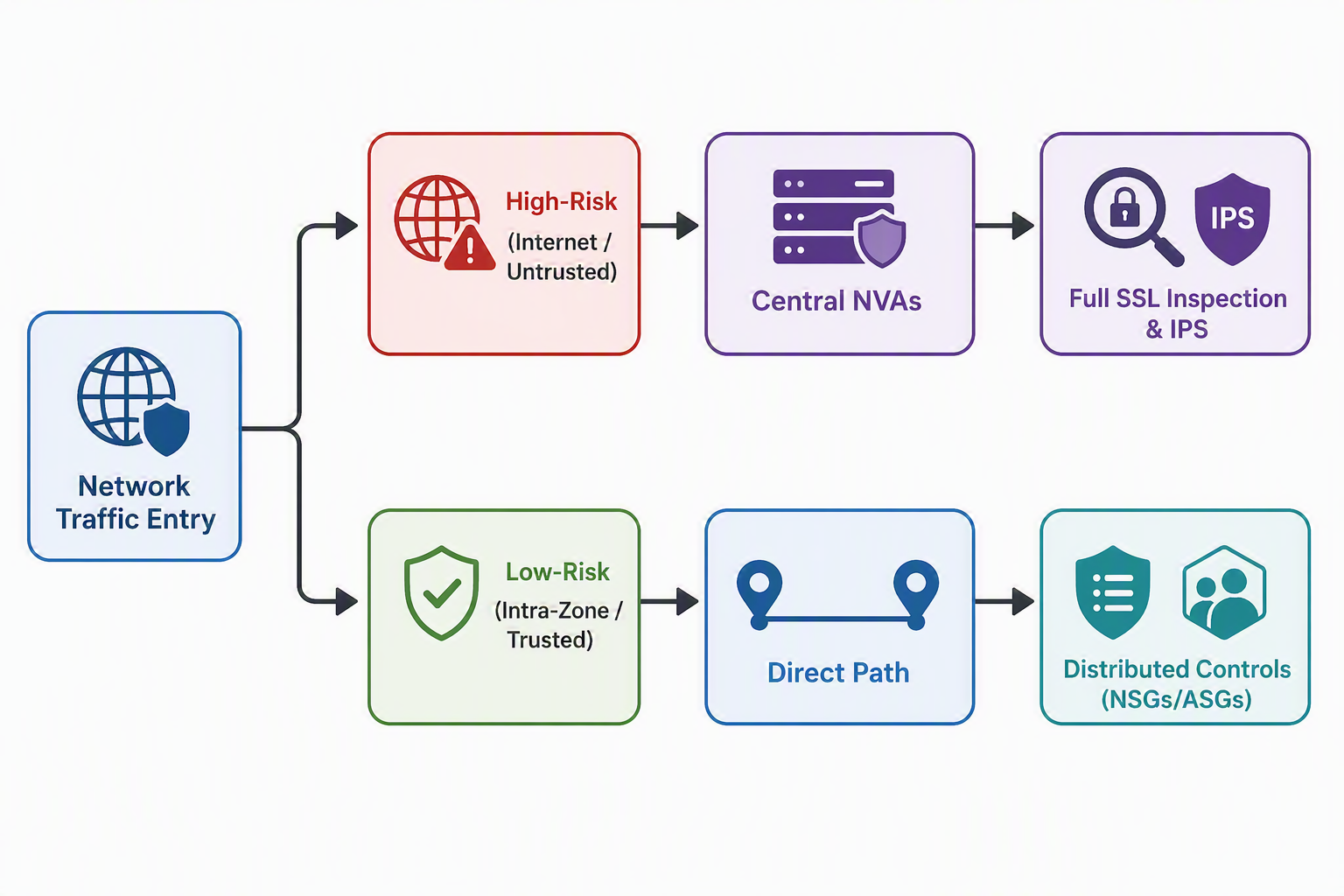
- Context-Aware Traffic Separation
Traffic is programmatically segmented into clear risk profiles rather than a single flat zone. Routing decisions double as security enforcement mechanisms:
- High-Risk Flows (Internet/Cross-Cloud): Retain centralized hub-and-spoke routing through NVAs for comprehensive threat validation.
- Low-Risk Flows (Intra-Tier/Identified Services): Bypass the central firewall hub via direct, optimized paths. Native software-layer controls enforce security using network-layer segmentation/microsegmentation control.
Instead of treating the network as a flat inspection domain, traffic is programmatically segmented based on risk and intent. High-risk traffic—such as internet-bound or untrusted flows—continues to leverage centralized NVAs and full inspection controls, preserving a strong security posture where it matters most. Meanwhile, native cloud constructs route low-risk, well-understood internal traffic directly using NSGs and ASGs, allowing enforcement to happen closer to the workload.
- Strategic SSL Inspection
Cryptographic decryption is reallocated based on risk priority:
- Full Inspection: Applied strictly to outbound user traffic, untrusted third-party integrations, and unverified external endpoints.
- Bypass / Minimal Inspection: Applied to predictable, authenticated internal infrastructure traffic (e.g., LDAP, database syncs), eliminating unnecessary cryptographic compute overhead.
This approach refines network security in the modern enterprise cloud without sacrificing control. Inspection becomes more precise, cryptographic overhead is applied where it is meaningful, and network paths are optimized for performance.
Conclusion
At its core, the problem is not that enterprises lack security controls — it's that those controls are applied indiscriminately, creating performance bottlenecks, increasing costs, and complicating operations without proportionate risk reduction. The context-aware traffic model resolves this by aligning security enforcement with actual risk, ensuring that high-risk traffic remains fully inspected while trusted, internal flows are optimized and governed closer to the workload. The result is a more efficient security infrastructure, improved application performance, and a scalable architecture that better supports cloud-native growth. This approach makes business and technical sense because it delivers stronger security precision, measurable operational efficiency gains, and a clear reduction in unnecessary infrastructure spending—all while enabling the agility your application teams expect in a modern cloud environment.